Franchise Thinking
On the sequel economics of ideas.
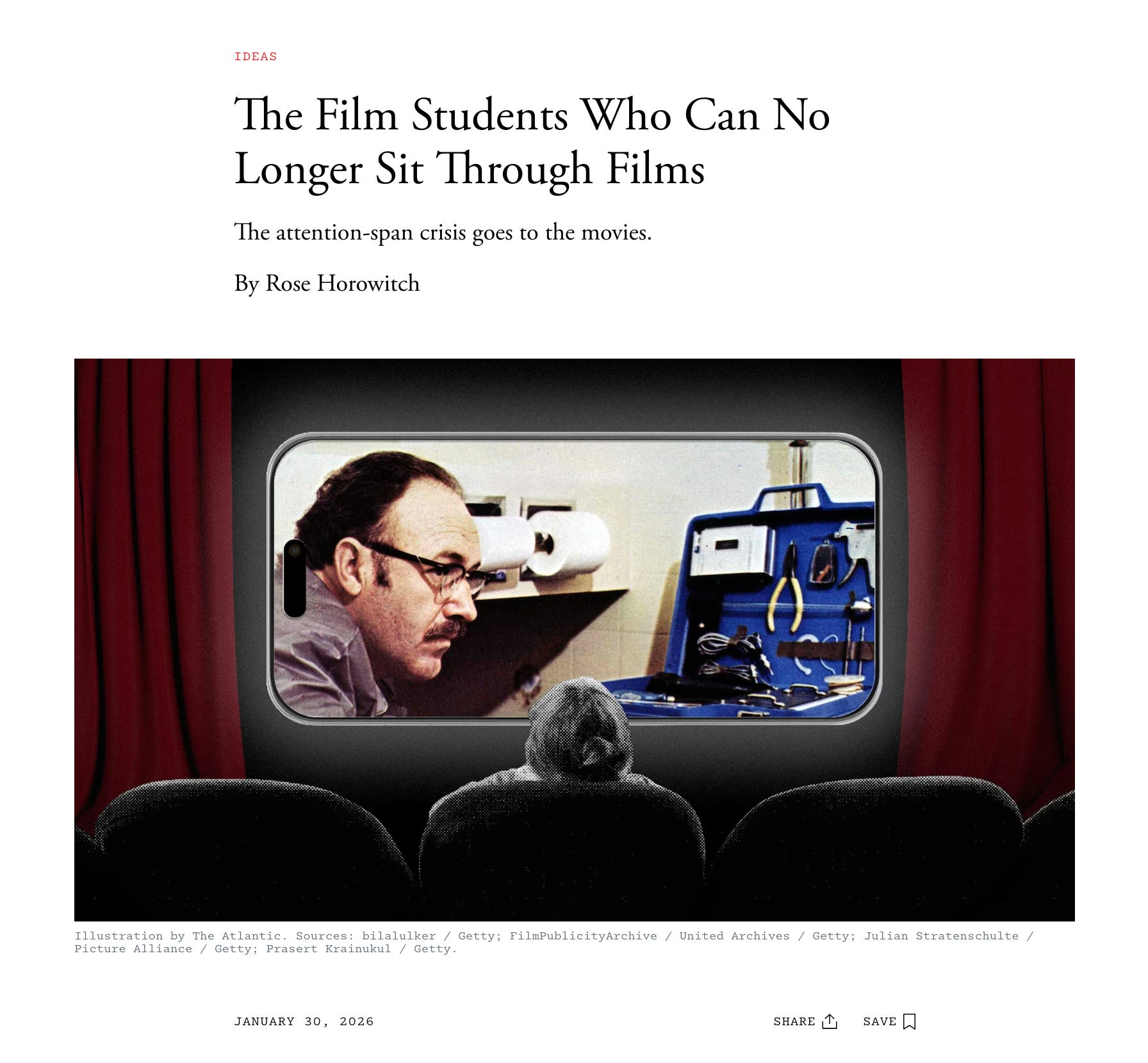
Last week I read an article in The Atlantic lamenting that film students can’t sit through feature-length films anymore. As one professor put it: “I used to think, If homework is watching a movie, that is the best homework ever … But students will not do it.”
The culprit, according to the article and fervent online discourse: the attention-span crisis. The phones have fried their brains, they say. Case closed.
There isn’t all that much thought or word count put into alternate explanations:
Is the phenomenon of students trying to skirt assignments new? Are students struggling to watch all films, or just some? Is the feature film format losing its relevance? Was the two-hour theatrical feature a product of technological, social, and economic context that no longer applies? What are these students watching, making, and studying instead?
I’m more curious to know the answers to these questions.
Someone somewhere must be pondering them, but not the mainstream new media. They don’t feel the need, because they already have a template. “Attention crisis” was the answer before the investigation even began.
The article isn’t provably wrong — just prematurely satisfied. This seems to be the case with so much thinking today, from citizens and journalists alike.
This is what I call Franchise Thinking.
Franchise thinking is the tendency to fit everything into ideas that already have names, audiences, and tribal alignment rather than to look for new ones.
Dawkins gave us “memes” — ideas that spread like genes. Franchise ideas are the memes that become infrastructure: narrative containers so big and vague they can hold anything. Memes tend to be small, neutral, and packaged as less “serious.” Franchise ideas are big, vague, totalizing, and often moralizing. Memes spread because they’re catchy; franchise ideas spread because they’re also safe. While memes explain spread, franchise thinking explains people and persistence.
Franchise thinking is choosing the template over the original. The intellectual class, which loves to imagine itself above this, is among the worst offenders.
The franchise model rules our discourse for the same reason it rules Hollywood: franchises are safe bets. The characters are known, the audience pre-built, the conclusion pre-accepted. Introducing an original idea is buying a lottery ticket — on rare occasion, you win big, but mostly you look stupid for trying. But sequels are sure things — pure dividends. Phones are destroying us, attention is fragmenting, we’re lonelier than ever, birth rate is collapsing, AI is evil. The sequels write themselves.
And in an algorithmic world, distribution favors the familiar. The algorithm feeds what’s already fed. Franchise thinking survives on the sequel economics of ideas.
Too many people are making something already known more known instead of making something new.
Franchise thinking works like this: Start with a pre-existing narrative. Find a phenomenon that fits. Attribute the specific to the general. Overfit. Present the attribution as explanation. This is the pivotal step, where correlation gets dressed up as air-tight causation. This is fan service masquerading as analysis.
Then flag more examples (ones that are hard to falsify), give the movement a catchy name, build a coalition that benefits from the alignment. And amplify.
This extends far beyond just journalists writing sequels to the current crisis. Founders franchise their pitch to fit the thesis VCs already hold. VCs pattern-match instead of underwriting the new. And we all do it to explain our own lives.
The most successful idea franchises are timely, unfalsifiable, and totalizing.
The scapegoat of the century is “phones” — and it checks all three boxes. Teen anxiety, loneliness, short attention spans, low fertility rates, political polarization. I’m not saying phones are innocent — technology undeniably drives culture. But true causation is specific and contextual. Franchise thinking has no use for this.
Explanations so broad can’t be disproven. Counterevidence becomes an exception or gets reframed as supporting the thesis. This is why franchise ideas persist long past their usefulness. They’re not falsifiable claims about the world. They’re narrative containers that can hold anything you put in them.
The original requires looking at the world. The sequel is catechism.
So many of these idea franchises are decline or crisis franchises — negative sentiment triggers that assign blame, induce panic, and ultimately get clicks. There are the tech panic franchises, culture war franchises, and macroeconomy franchises. The inverse exists too: hype franchises. The AI hype franchise treats every demo as proof of imminent superintelligence. It treats a pandering-to-tech-culture “AI agent social network” toy site as the next sign of “the takeoff.”
Franchise thinking is exculpatory — it locates any problem outside the person making the diagnosis, and outside their culture, community, and profession.
The professor says students can’t watch films because of the attention crisis — not because the format itself might be losing relevance (and their expertise with it), or the curriculum might need updating, or the pedagogy might be mismatched to how this generation learned to see. Phones broke the kids, not my parenting. Social media broke democracy, not the failures of institutions I belong to. The meaning crisis broke the culture, not the frameworks I’m still selling.
In public discourse, we rarely move from idea to idea. We move from franchise to franchise.
The unit of discourse isn’t the insight but the narrative container. You encounter “the attention crisis” as a total package — the premise, the villain, the implication, the emotional response. You buy the whole franchise or you don’t.
And when one franchise exhausts itself, you don’t go looking for a new idea. The movement is lateral — franchise to franchise — never down to the thing itself. The attention crisis gives way to the meaning crisis gives way to the loneliness epidemic.
Eventually, franchises cross over. They build a cinematic universe of interlocking narratives. The whole cinematic universe coheres because the franchises are mutually reinforcing. Once you’re inside the universe, it’s hard to see outside it.
This is darker than “people make sequels.” It suggests our capacity to look directly at phenomena is atrophying, and it’s a self-fulfilling prophecy. The franchise becomes the only way to see. You literally cannot perceive teen anxiety except through the attention crisis frame, because that’s the frame that’s been incepted into everyone’s head. It gets harder and more expensive to abandon it.
Your idea gets franchised or it disappears.
Franchise thinking has become the dominant kind of thinking that’s legible and profitable. Newness is harder to understand instantly, harder to market, and harder to price. Even when an original idea works, success means sequelization. The only original that stays original is the one that never spread. But then you don’t matter. The modern intellectual infrastructure is built for idea franchises.
The alternative to franchise thinking is not contrarianism. That’s just another kind of sequel, the reboot that inverts the original. It’s Joker as protagonist in the Batman universe. The alternative is earnest investment in new ideas. This yields less confident conclusions. You can’t write a viral essay that says “it’s complicated and I’m not sure.” But this is the only path to truly novel insight.
Originals don’t have audiences yet. That’s what makes them originals. The alternative to franchise thinking is patience — and looking stupid for a while.
Franchise thinking makes us fragile.
We talk about LLMs eroding our ability to think for ourselves, write for ourselves, decide for ourselves. But franchise thinking has been doing this forever. LLMs are weighted toward consensus frames we’ve already amplified, but they also contain non-consensus frames that we’ve ignored. It’s up to us which ones we ask for.
To be fair, the benefit of franchise ideas is shared language. Common frames for describing, processing, and experiencing things together. They help us coordinate around our causes. But there’s a fine line between utility and lazily consolidating narrative power. Shared language helps us think together. Franchise thinking is when the template replaces thought.
The franchise model of ideas isn’t evil. It’s economically rational.
People make sequels because sequels work. Entire careers can be built from franchising just one idea. The platforms say post it again, and the economics say keep collecting the royalties. The problem with franchise intellectualism is that sequels crowd out originals. Originals get harder to find and to fund. Before you know it, you’re making Fast X.
The hardest franchise to resist is your own.
I’m not immune to this. The analytics are instructive. And I can’t help but be flattered when my ideas carry, are picked up and remixed. There is a world in which I’d only be writing essays about AI, taste, and making heavy things because I know writing on these topics spreads. But I can’t bring myself to franchise my existing body of work forever. I strive to write when compelled by some new insight.
Franchise thinking is convenient and economically rational — but it is worth resisting. We cannot be beholden to the power laws of idea markets alone, especially when our identities so often rely on preaching otherwise. Truth-seeking is an art worth reclaiming.
If you produce ideas, don’t let the validated crowd out the emerging. If you curate ideas, don’t be beholden to consensus and algorithms. And if you consume ideas, gravitate toward what you don’t yet understand instead of going all-in on the ones you already do. Because otherwise — it’s sequels all the way down.
Cover art: Not to Be Reproduced, 1937 by Rene Magritte


I’d avoid zooming out too far. it’s easy to slide into nihilism, where everything starts to feel equally meaningless.
You don’t need a total theory of life to act well. Having some grounded, positive orientation already does a lot of work.
When you hold a workable sense of meaning and let it guide concrete action, lt’s a practical way of staying oriented without losing yourself to emptiness.
I enjoyed this article but ironically it is guilty of a lot of the sins it lays at the feet of "franchise thinking"!
The "totalizing claim" - all of these wildly different phenomena all get attributed to one vague general mechanism that is "franchise thinking".
The position is "unfalsifiable" - any example of someone using an existing framework to explain something gets filed as "franchise thinking".
And, it fits nicely into pre-existing audience expectations, written for an audience already with the pre-conclusion that mainstream discourse is shallow.
"why people can't think originally anymore" is one of the oldest intellectual franchises in existence!