

The Freaks Are the Last to Go
There’s pleasure in having to work for something. Maybe not everyone thinks so.
There is a particular kind of nightmare: a movie where the protagonist spells out the entire backstory within the first two minutes. Or worse, a side character inserted for no reason except to transmit the plot, line by line, straight into your brain.
There’s a kind of magic when you watch something - or read something - that feels almost nonsensical and yet by the time it’s over, you know exactly what it means and you’ve been unwittingly forced to unlock new ways of seeing and feeling the world.
That is what the brilliant freaks among us offer.
Their minds generate near-nonsensical brilliance like it's on tap. The freak's gift is folding meaning into shapes so dense that unpacking them requires work. And it is fun. To engage a freak's mind is to submit to a series of enjoyable puzzles. Their brilliance is in encoding meaning just hard enough to decipher.
Compression is a hallmark of creative intelligence.
It is novelty and soul folded into form.
And it is a wager.
The window is impossibly narrow. Too obscure and it’s utter nonsense; too legible and it’s just information. There is compression for the sake of efficiency, but this is not what freaks do. Freaks refuse to trade depth for clarity.
Legibility is retrospective. Creativity is prospective.
The best creative minds compress meaning to the edge of illegibility.
There’s magic in timing too - in understanding that arrives a half-beat after intuition. Great comics land jokes precisely in this gap between stimulus and cognition. You laugh before you can articulate why it’s funny (if you had to articulate it first, you wouldn’t laugh). The same is true of movie scenes where there’s little talking yet everything is said. Meaning encoded in silence.
Freak is a term of admiration. Brilliant alone doesn’t capture it. To call them weird is weak, genius is flat, visionary is corporate.
Freaks have texture. They’re permeable to context but impermeable to noise. Their references are strange, their conclusions stranger still. They’re rare without ever seeking to sit atop a hierarchy.
A freak with a secret is who you want to bet on, and early.
You’ll find them on stages and in basements. They build companies and make art and run kitchens. They do it all sideways.
The truest freaks are hardest to name — not out of coyness but impossibility. The act of naming is the first step of sanding, of success sanitizing. By the time I could point to them, you’d already be receiving the flattened version. The freak exists most fully in the moment before consensus. You had to be there.
We label freaks aesthetically different, but they’re cognitively different first. They do not explain, because the freak’s instinct is knowing when explanation would ruin it. That instinct is a kind of taste.
Most of the garbage we consume doesn’t trust us at all. It hypes itself, explains itself, narrates its own subtext. We accept that the literal is sedative and still keep ourselves busy with one-step deductions. Algorithms route what we’ll love or lash out against. Frictionlessness wins. And we follow suit — flattening ourselves to be legible, to be palatable, to be picked.
Modernity is obsessed with legibility.
The most interesting people aren’t.
That’s why we love freaks.
They trust themselves, and they trust us.
You know when you’ve stumbled upon one because you feel lost or stupefied or stupid for a while - and then suddenly smarter for it. Freaks keep friction alive. They insult and flatter us all at once. Joyous frustration.
Their breakthrough is finding the compression ratio that gifts others a momentary visit into their world. The reward is their work and the elevation of everyone who comes to understand it.
Culture flattens. The literal goes first. Then the competent. Then the good. Who's left? The stubborn. The illegibles. The freaks. The ones whose gift is a taste for the creative wager — for exactly how close to nonsense we must tread to unlock the magic.
The freaks are the last to go.
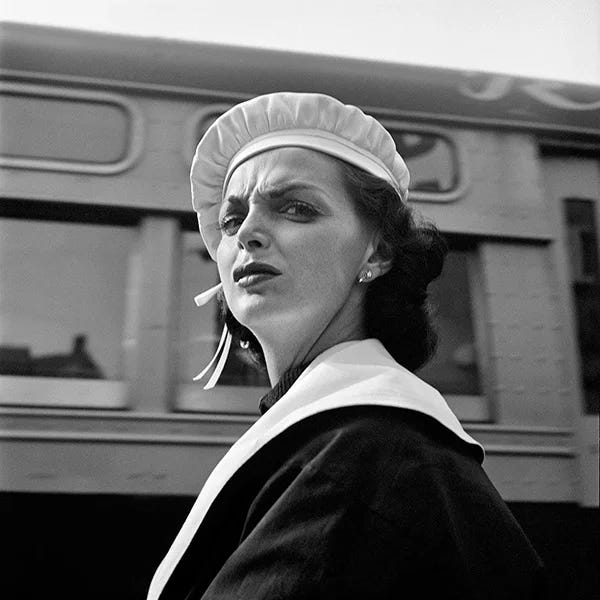
Cover photo: Vivian Maier