

Make Something Heavy.
We're creating more than ever, but it weighs nothing.
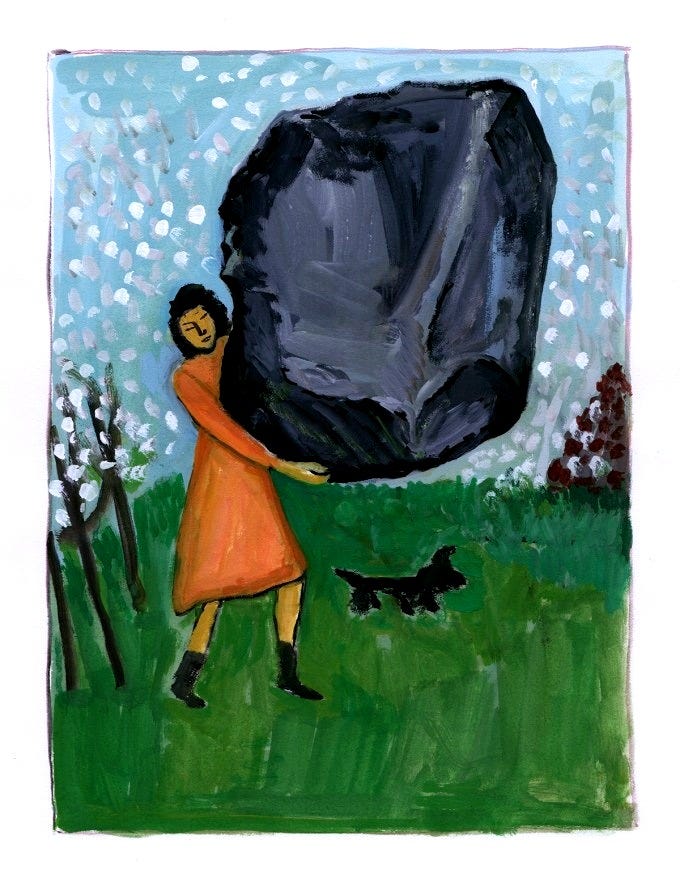
We instinctively tie weight to value.
Gold is solid. Wood is dense. And back when we still printed things on paper, a heavy stapler was a luxury.1 If something is heavy, we assume it matters. And often it does. Weight signals quality, durability, presence, permanence.
Even the objects we choose reflect this. At first, we buy cheap, lightweight furniture—easy to build, easy to trash. But eventually we want weight. A solid oak table. A leather armchair. Something that’s built to last. Heavy things comfort us—a weighted blanket stills the body and a heavy door makes a home feel secure.
Winners of major awards almost always say the same thing as they lift the trophy: ‘Wow! It’s so heavy.’ As though the weight itself validates the achievement. Simple logic: Light achievements beget light awards. Heavy achievements beget heavy awards.
We accept this in the physical world.
But online, we forget.
The internet is (mostly) a machine for light things.
The modern makers’ machine does not want you to create heavy things. It runs on the internet—powered by social media and fueled by mass appeal, addicted to its own speed. It thrives on endless scrolls and screenshots. It resists weight and avoids friction. It does not care for intention, patience, or anything but production.
It doesn’t care what you create, only that you keep creating. Make more. Make faster. Make lighter. (Make slop if you have to.) Make something that can be consumed in a breath and discarded just as quickly. Heavy things take time. And here and now, time has become a tax. And so, we oblige—everyone does.
We create more than ever, but it weighs nothing.
AI now promises faster results and without the same reckoning, but frictionless creation leads to weightless rewards. No one dreams of merely pushing a button to generate their magnum opus. The output matters, but the intention, the struggle, the care is what makes it count, and what gives it weight.2
Yes, there’s a range from light to heavy and not all light things are bad. An entire economy thrives on lightness. Tweets, memes, breaking news, and celebrity gossip shape culture. But movement isn’t meaning and a million views isn’t a pound of significance. Light things shape culture but rarely us.
Creation is a process of becoming. The best work shapes the maker as much as the audience. A founder builds a startup to prove they can, a writer wrestles an idea into clarity. You don’t just make heavy things. You become someone who can.
Many light things don’t add up to one heavy thing.
So many creators start in the shallow pool of some algorithm’s grip until, inevitably, they go searching for something heavier. From short-form to long-form and timely to a little less timely and to timeless. From building in public to locking in to solitude, obsession, deep work. To create a book, a film, an album, a company—something that stands alone.
No matter how many you stack, Tweets and TikToks don’t add up to something heavy. They don’t solidify. At best, they’re a pile of snowflakes, crystally-complex yet ephemeral—beautiful while they’re here and gone before they hit the ground.3
Substack, with its many virtues, finds itself at a crossroads. I’d position it in the midweight creation zone (if used well). Writers stack posts, building up a library of words that starts to feel substantial. It’s good that long-form posts can go viral faster and stick around longer. But it’s still not quite as heavy as writers’ loftiest dreams, at least not yet. Even the most successful Substackers, those who’ve turned newsletters into brands and businesses, start pondering their endgame.
They want to make one really, really good thing. One truly heavy thing. A book. A manifesto. A movie. A media company. A monument. — A masterpiece.4
Not just for the prestige or the money, but for the proverbial "F-U" to ephemerality. For the way it anchors them to something lasting while giving them the freedom to breathe. For the way it sticks in the hearts and minds of other people who encounter it too.
Heavy projects are the lifeblood of creative fulfillment — and creative longevity. And for now, no platform truly offers that kind of weight on its own. Platforms are built to amplify, not anchor.5
You’re either making in light mode or in heavy mode.
Light mode is fast and iterative, producing work that’s quick to make but just as quick to fade. It’s the mode of rapid experiments, side quests, and prolific posting. Heavy mode is slower and more deliberate and intentional (it’s often hermit mode). It’s the mode of deep work that builds over time and carries lasting weight.
Some go straight for the heavy thing: first-shot building the billion-dollar startup, writing the world-changing book, and recording the defining album. Or, in less relative terms: things that will stand on their own and stand the test of time. Weight is lindy.6 Others build up slowly to the heavy things: essays before the book, short films before the feature, prototypes before the big product (maybe a few silly ‘GPT wrappers’ before the serious one). Lightness has its virtues in that it helps keep you fresh and get in the reps and work your way up to the heavy thing.
At any given time, you’re either pre–heavy thing or post–heavy thing. You’ve either made something weighty already or you haven’t. Pre–heavy thing people are still searching, experimenting, iterating, and feel lost. Post–heavy thing people have crossed that threshold. They’ve made something of substance that feels like it, gets respect, inspires, and becomes a solid base to build on. And it shows. They move with confidence and calm (but this feeling doesn’t always last forever.)7 Your gut will tell you what state you’re in. And quite often the cycle repeats.
No one wants to stay in light mode forever. Sooner or later everyone starts gravitating toward heavy mode. Whatever you consider your ‘life’s work’ will be heavy, and finding the balance of light and heavy along the way is the game.8
Note: heavy doesn’t have to mean “big.” Heavy can be small, niche, hard to scale. What I’m talking about is more like density. It’s about what is defining, meaningful, durable.
You feel like an imposter when you only make light things.
Everyone calls themselves a creator now. It’s the default title of the moment, the identity of an era. But does everyone who claims it earnestly feel it?
Telling everyone they’re a creator has just invented a new strain of imposter syndrome. Because bing called a creator doesn’t make you one or make you feel like one. When you’ve made something heavy—something that stands on its own—you don’t need validation. You just know. The weight is its own reward.
It’s not that most people can’t make heavy things. It’s that they don’t notice that they aren’t. Lightness has its virtues—it pulls us in, subtly, innocently, whispering, 'Just do things.' The machine rewards movement, and so we keep going, shuffling our feet to collect all the badges. One day we look up and realize we’ve been running in place.
And then you feel it: a quiet, gnawing hollowness that for all the making, maybe nothing has truly been made. Why does it feel bad to stop posting after weeks of consistency? Because the force of your work instantly drops to zero. It was all motion, no mass. Momentum without weight. 99% dopamine, near-zero serotonin, no trace of oxytocin. This is the contemporary creator’s dilemma—the contemporary generation’s dilemma.
You don’t feel like a true creator because you haven’t made anything heavy, and deep down, you know light things don’t count. Your output is high but your imprint is low. You ship but you do not build. You call yourself a creator but what have you made that could survive a month offline? A year? A decade? If you stopped posting tomorrow, would anything remain? Creating for 24-hour cycles isn’t the freedom or leverage it’s sold as. It is just renting out your time.
The weight of what we make matters.
Creative people are restless souls forever chasing the horizon until they’ve made something substantial. We spend our lives crafting weighted blankets for ourselves—something heavy enough to anchor our ambition and quiet our minds.
Weight is tangible in the physical world—the place we should care about and create more for than we have of late even if it’s harder to scale. Working with your hands, with weight and shape and dimension holds an abundance of untapped virtue and value. Online, by nature, weight is harder to find and to hold on to, and it’s only getting harder in a world where it feels like anyone can make anything.
But it is just as imperative.
People ask, "What are you working on?" They’re really asking: What’s your endgame? (It’s one of my favorite questions, too.)
My answer is simple but not easy:
Make something heavy.
If you enjoyed this essay, consider sharing it with a friend or community that might enjoy it too. This is a topic I care deeply about, so I welcome reflections and questions. Email me here or DM via Substack or Twitter / X.
Related essays: The Aesthetic Is The Art Now, Taste Is Eating Silicon Valley, Your dreams demand your best hours, Pursuits that can’t scale, Status limbo.
In the spirit of walking the walk, sharing one heavy creative project on my mind below. If you’ve read this far and want to support me in such an endeavor, DMs open. 🙏
My dad gave me an appreciation for quality in material and form and utility from a young age and it has unwittingly grown with me. Fond memories of amateur carpentry and summertime stone masonry and my own pursuit of crafting avant-garde materials into whimsical apparel I called fashion. I still gravitate towards weighty wood and polished stone and the densest metal objects.
AI making things easier to create and easier to disrupt, so it largely wipes out moats and the middle of any given category.
Not all “light” and “heavy” things are created equal. Some light things can be considered more weighty, and may stack to some effect. To borrow a construct from one of my favorite authors, George Orwell: All light things are light, but some light things are lighter than others. All heavy things are heavy, but some heavy things are heavier than others.
I understand what may be considered a masterpiece, what feels “heavy” to us, will change over time — culture is a powerful influence — but there are some objective attributes that I believe remain consistent judges of heft (I may explore this in a future essay).
Platforms build compounding power through network effects, benefiting themselves. They scale through you. Your job is to build network effects around yourself, your own work, the value only you create. That’s how your work gains weight beyond you.
I decided not to go on this tangent, but in many ways, having children itself is making something heavy, and something that on its default course is enduring beyond yourself. Weight is not restricted to “work” in a traditional sense but to every arena of meaning.
Not everyone who endeavors to create something significant will 'succeed' by their own early definition, but to endeavor itself is important, and the definition of success will be shaped by the journey.
Note: heavy doesn’t always mean “big.” Heavy can be small or niche or hard to scale. What I’m talking about is more like density. It’s better understood as what’s defining, meaningful, durable.
This is a read that will sit with me for a long time. Thank you.
Brilliant writing, and hits me right in the soul.
I've taken a liking to architecture recently because, by nature, permanence is a key feature in a building. The world grows and changes around the building rather than consuming and moving on.
This piece calls me to make something not to be consumed, but to be lived and experienced for years to come even as the world around it changes.
Thank you so much for sharing